Blog February 25, 2026

Cyanide-Free or Alternative Cyanation Methods

The criticality of a cyanation agent in chemical synthesis is paramount, primarily due to the extreme toxicity of most traditional cyanide sources and their significant impact on reaction efficiency, selectivity, and safety. Key aspects of their criticality include:

  • Toxicity and Safety – Traditional agents like HCN, NaCN, and KCN are highly poisonous and can be fatal if swallowed, inhaled, or in contact with skin cause cancer.
  • Reaction Efficiency and Catalyst Poisoning – Uncontrolled release of free cyanide ions in a reaction medium can poison the transition metal catalysts.
  • Waste Generation – Many traditional metallic cyanide sources, such as CuCN and , produce stoichiometric amounts of heavy metal salt waste, posing environmental challenges and disposal issues.
  • Reaction Conditions and Scope– Trimethylsilyl cyanide (TMSCN) is moisture-sensitive and readily releases HCN, while other agents may require high temperatures or specific catalysts.

Recent advances focus on using low-toxicity or in situ generated “CN” sources to improve safety and sustainability.

Alternative Reagents & Sources for cyanation:

  • Acetonecyanohydrin ((CH3)2C(OH)CN)
    Acetonectanohydrin is less toxic liquid that can serve as an in situ HCN source or a direct transfer agent in transition-metal-catalyzed reactions.

    (CH3)2C(OH)CN + LiH → (CH3)2CO + LiCN + H2
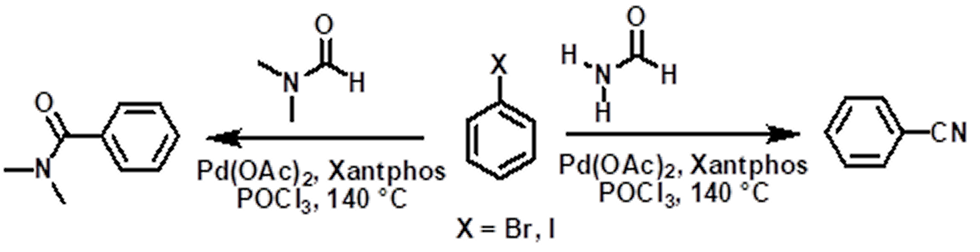
  • Formamide:
    HCONH2: Can act as both a non-toxic cyanide source and a solvent in palladium-catalyzed reactions.
  • CO2 and NH3: A highly sustainable approach using copper or nickel catalysis, where carbon dioxide and ammonia serve as the sole sources of the carbon and nitrogen atoms of the nitrile group. This method produces nitriles without using any toxic metal cyanides.
  • Organic nitriles: Solvents such as acetonitrile can even be used as the cyanide source in some specific nickel-catalyzed reactions. These alternative methods offer significant advantages by reducing the reliance on highly poisonous materials while still achieving high yields and good functional group tolerance.
